
From Zhangxue Motors to Open-Source Handhelds: Decoding the Atomization of Chinese Manufacturing
| cluyff
I. The 4-Second Shockwave: Chinese Manufacturing Breaks a Century of Barriers
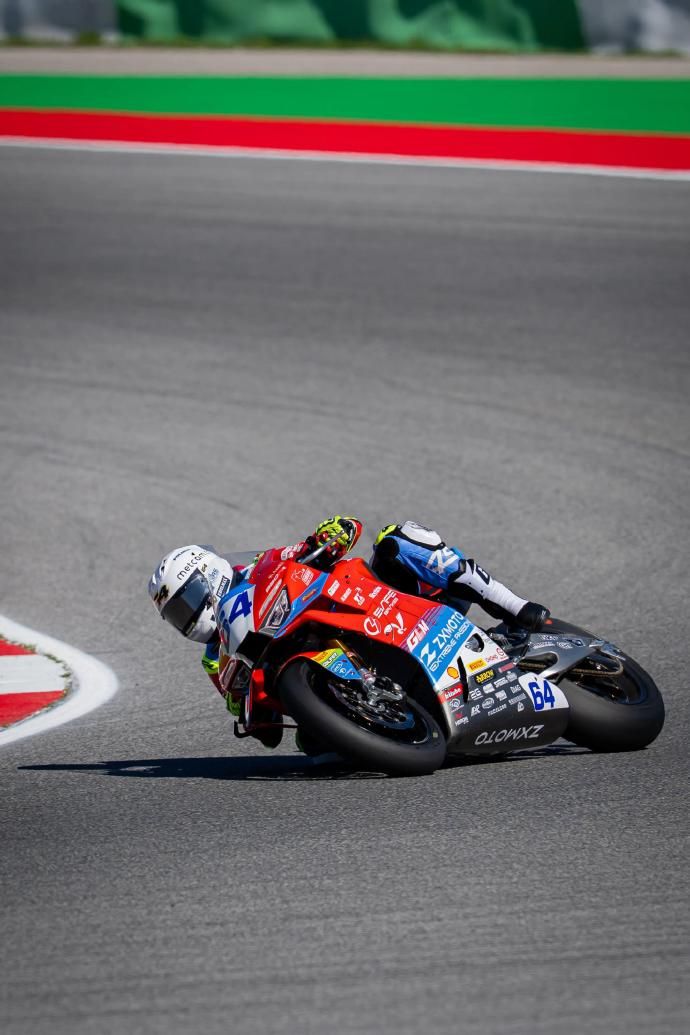
March 28, 2026. Porto Circuit, Portugal.
The Zhangxue Motors 820RR-RS crossed the finish line 3.685 seconds ahead of Ducati—not a nail-biter, but an absolute demolition.
When French rider Valentin Debise waved the Chinese flag, Ducati's engineers stood in disbelief. They couldn't fathom why a Chinese motorcycle brand from Jiangmen could dominate the European giants that had ruled this sport for decades.
The answer doesn't lie in the mind of some genius engineer. It lies in the factories across 9.6 million square kilometers.
II. How Much of China's Supply Chain Fits Inside One Motorcycle?
Let's tear down this championship-winning machine.
��️ The Powerheart: Engine
The Zhangxue 820RR carries an 819cc triple-cylinder engine delivering over 150 horsepower.
The crankshaft housing, cylinder block, and pistons—precision-machined metal components down to the millimeter—come from Jiangmen's local casting industry cluster. One out of every five motorcycles exported from China comes from Jiangmen. Since the 1980s, when Japanese motorcycle companies set up factories here, the first generation of trained workers has now passed their skills on to the second and third generations.
Precision isn't achieved through German machine tools. It's accumulated through 30 years of know-how in Chinese factories.
�� Energy Supply: Battery System
The racing battery comes from Tianneng Power—a Hangzhou-based company specializing in high-performance lithium batteries.
Interestingly, Tianneng doesn't exclusively serve the motorcycle industry. Its customer list also includes drone manufacturers, military equipment suppliers, and electric vehicle brands.
A web of battery technology that cross-pollinates industries. This is the unique advantage of China's supply chain—you never know which industry a seemingly ordinary factory will empower with critical components tomorrow.
�� The Intelligent Brain: Electronic Control System
The racing machine's smart instrument cluster, T-BOX connected module, and body controller come from Hongquan Technology.
Hongquan also serves as a Tier 1 supplier to multiple new energy vehicle brands. When the EV electronic architecture revolution spilled over into motorcycles, Zhangxue Motors simply rode the wave.
This isn't coincidence. It's a snapshot of how China's electronics industry expands horizontally.
⚙️ The Drivetrain: Precision Machinery
The racing drivetrain, chains, and belts come from Zhenghe Industrial—a hidden champion honing precision mechanics for decades.
Zhenghe's customer roster includes construction machinery, agricultural equipment, and medical devices. It wasn't born for motorcycles, but it can make anything.
��️ Full Vehicle Manufacturing: The Jiangmen Cluster
Body stamping, welding, painting, and final assembly—all completed within a 50-kilometer radius in Jiangmen.
This isn't an exaggeration. The Guangdong Jiangmen-Foshan-Dongguan motorcycle industry belt has the most complete two-wheeler supply chain ecosystem in China: over 2 million square meters of parts markets with over 3,000 merchants. For any single bolt, you can find at least three suppliers here.
III. Why Zhangxue? Why Not Other Brands?
The answer is simple: he stands on the shoulders of Chinese manufacturing.
Among the many domestic motorcycle brands, Zhangxue Motors achieved a 91% domestic supply chain localization rate.
Nearly every critical component on this racing machine—engine, battery, electronics, drivetrain, brakes, suspension—bears a Chinese supplier's name. This isn't isolationism. It's the natural result of Chinese supply chain strength.
When European brands are waiting three months for a single component, Zhangxue Motors finishes lunch in Jiangmen and picks up new samples in the afternoon.
When Japanese brands hold three-day meetings with suppliers over a bolt's precision, Zhangxue's engineers walk directly into the supplier's workshop and fine-tune on the spot.
Speed is Chinese manufacturing's most underestimated competitive advantage.
IV. From Two Wheels to Handhelds: The Chinese Moment in Open-Source Hardware
By now, you might ask: so what if motorcycles are strong?
Let's zoom out.
If you've followed the open-source handheld gaming market, you'd see an even more fascinating story.
An Odin 2 handheld, priced at around 2,000+ RMB, smoothly runs PS2, PSP, and even some Switch games. Behind this:
· Rockchip RK3588 chip: Made in China
· Full Android open-source ecosystem: Chinese developers contributed extensively
· Huaqiangbei SMT capabilities: Any board, two-week sample turnaround
· Shenzhen structural factories: Molds cost one-tenth of Europe/America
Looking at entry-level ESP32-S3 open-source handhelds: using Espressif's domestically-made chip, you can build a programmable gaming device with just 60 RMB in components.
This isn't trivial tinkering. It's a complete technology ecosystem:
Layer | Chinese Advantage |
Chip Design | Espressif, Rockchip, Amlogic... |
Chip Manufacturing | SMIC, Hualong... |
PCB Production | Huaqiangbei, Shenzhen Standards... |
Structural Components | Shenzhen-Dongguan-Foshan Belt |
Operating System | Android Open Source, AOSP |
Software Ecosystem | World's Largest Developer Community |
V. When Chinese Manufacturing Meets Open-Source Handhelds: A More Compelling Story
If you've followed the open-source handheld gaming niche, you'll discover a story that illustrates the point even more powerfully.
�� What Are Open-Source Handhelds?
They're not Switch knockoffs or PlayStation substitutes.
Open-source handhelds are portable gaming devices built on open-source hardware and systems, allowing users to freely flash firmware and customize their experience. They can emulate virtually every classic gaming platform—from the FC/NES and PS1 to PSP and PS2.
A Chinese handheld priced at 500-2,500 RMB can smoothly run Switch-level games.
This isn't piracy or counterfeiting. This is industrial chain domination.
�� The Chip Chapter: The Full Rise of Chinese Chips
The SoC (System-on-Chip) is the "brain" of an open-source handheld. In this space, Chinese manufacturers have nearly monopolized the mid-to-high-end market:
Chip Model | Manufacturer | Process | Performance Tier | Representative Handheld |
RK3588 | Rockchip (Fuzhou) | 8nm | Flagship, PS2/Switch capable | Odin 2 Pro |
RK3566 | Rockchip (Fuzhou) | 22nm | Mid-high, smooth PSP/PS1 | Retroid Pocket 4 |
T618 | UNISOC | 12nm | Mid-range, PSP ready | Various entry models |
T310 | UNISOC | 12nm | Entry-level, PS1 fully supported | High value models |
ESP32-S3 | Espressif (Shanghai) | 40nm | Ultra-budget, FC/GBA tier | 60 RMB open-source handheld |
Allwinner A133 | Allwinner (Zhuhai) | 14nm | Mid-range, power-performance balance | Various Android handhelds |
Why all Chinese chips?
Because only Chinese companies are willing to customize chips for this "niche" market. MediaTek won't do it. Qualcomm won't do it. Samsung won't do it. Only Chinese SoC vendors, leveraging their technology foundations built from tablets, media players, and in-vehicle entertainment, have casually covered the handheld market.
More importantly, these chips weren't designed specifically for handhelds. The RK3588 was designed for smart cockpits and edge computing. The T618 was designed for mainstream tablets. The ESP32-S3 was designed for mainstream IoT devices.
Handhelds are just an overflow market for these chips. And this kind of technology spillover can only come from China's complete electronics industry chain.
�� The Components Chapter: The Hidden Kingdom Behind Every Handheld
Displays
Handheld screens mainly come from:
· Tianma Microelectronics (Shenzhen): Focused on small-to-medium displays, world's #1 in automotive displays
· BOE: World's largest LCD panel factory, full coverage of high-refresh and OLED screens
· TCL CSOT: Leading foldable and curved screen technology
For a 5-7 inch handheld screen, China's supply chain can complete the journey from spec definition to mass production delivery in just two weeks. Europe and America? At least three months.
Batteries
Handhelds are compact, demanding high battery energy density. This happens to be the biggest advantage of China's new energy industry:
· ATL (under CATL): Global leader in consumer electronics batteries
· EVE Energy: Expert in high-rate batteries
· Sunwoda: Battery supplier for Xiaomi and Huawei
A handheld battery with the same energy density costs 50 RMB in Japan but only 15 RMB in China. Not because of corner-cutting—because China's new energy supply chain is brutally competitive.
PCBs (Printed Circuit Boards)
The soul of a handheld is that green circuit board. Huaqiangbei's PCB prototyping:
· 48-hour delivery
· Starting at 5 RMB per square centimeter
· Minimum trace width of 0.1mm
Compare this: North American PCB prototyping often takes 2-3 weeks at 5-10x the cost.
Shells and Structural Components
A handheld's shell requires:
· Mold design and manufacturing (Shenzhen-Dongguan-Foshan)
· Injection molding (thousands of factories)
· Surface treatment (spraying, frosting, soft-touch coating)
· Handle micro-buttons (mechanical switches, tact switches)
In Shenzhen, a mold set costs one-tenth of Europe/America with one-third the lead time.
�� The Industry Chain Chapter: Huaqiangbei Is No Flea Market—It's an Industrial Operating System
If you disassemble an open-source handheld, every single part can be traced to a specific industrial cluster in China:
Component | Main Origin | Industry Cluster |
SoC Chips | Fuzhou/Shenzhen | Rockchip, Allwinner, UNISOC |
Display Panels | Shenzhen/Wuhan/Suzhou | BOE, Tianma, CSOT |
Batteries | Dongguan/Huizhou | ATL, EVE, Sunwoda |
PCBs | Shenzhen | Huaqiangbei, Nanshan PCB District |
Molds | Shenzhen-Dongguan-Foshan | Countless SME mold factories |
Shell Injection | Shenzhen/Dongguan | Dozens of kilometers of factory belts |
Buttons/Handles | Pearl River Delta | Mechanical switch specialist factories |
Assembly | Shenzhen/Huizhou | Cutthroat contract manufacturer competition |
Within one square kilometer, you can manufacture every component of a handheld.
This is the truth about Huaqiangbei: it's not a "place selling fake goods," it's the world's most efficient electronics prototyping and verification center.
�� Why Only China Can Do This?
Now, let's zoom out to the global picture:
United States
· Chip design: ✅ NVIDIA, Qualcomm, Apple
· Chip manufacturing: ❌ No fabs below 7nm
· PCB manufacturing: ❌ Limited, military-grade only
· Consumer electronics assembly: ❌ Virtually no skilled workers
· Verdict: Can design, cannot manufacture
South Korea
· Chip design: ✅ Samsung, LG
· Chip manufacturing: ✅ Samsung fabs
· Panels: ✅ Samsung Display, LGD
· PCBs: ❌ Mainly relies on China
· Assembly: ❌ Costs too high
· Verdict: Can make core components, but relies on China for parts and assembly
Japan
· Chip design: ✅ Renesas, Sony
· Chip manufacturing: ✅ Limited high-end processes
· Precision machinery: ✅ World-leading
· Consumer electronics ecosystem: ❌ Continuously shrinking
· Verdict: Strong in precision parts, but incomplete industry chain
Vietnam/India
· Chips: None
· Panels: None
· PCBs: Entry-level
· Assembly: Low-end contract work
· Verdict: Can only do the lowest-end, core components rely on Chinese imports
This is why:
�� Only China's electronics industry can manufacture an open-source handheld gaming device—from a silicon wafer to a finished product—through a complete, localized, low-cost domestic supply chain.
Not because Chinese labor is cheap—Bangladesh is cheaper. Not because Chinese policies are good—every country has industrial policies. Not because the Chinese market is huge—the US market is no small either.
Because China has the world's only manufacturing system covering ALL industrial categories.
From chip design (HiSilicon, Rockchip, UNISOC) to chip manufacturing (SMIC, Hualong Semiconductor), from display panels (BOE, Tianma) to new energy batteries (CATL), from precision molds (countless Pearl River Delta factories) to PCB manufacturing (Huaqiangbei's 48-hour turnaround), from firmware development (Android Open Source ecosystem) to software ecosystem (world's largest developer community)—
All can be accomplished within one country.
This isn't a choice. It's the only solution.
VI. Closing Thoughts
On the day Zhangxue Motors won the championship, I found myself asking:
Why China?
Not because some individual is a genius. Not because some company got lucky.
Because Chinese manufacturing has evolved an "atomization capability"—where every single component has countless companies competing, evolving, and expanding horizontally.
When this capability converges on a motorcycle, it crushes Ducati. When it converges on a handheld, it lets global gamers play PS2 games for a few hundred bucks. When it converges on any industrial product, it redefines what "value for money" means.
This isn't just manufacturing. It's a manufacturing operating system.
And China is the only country running a complete industrial ecosystem.

